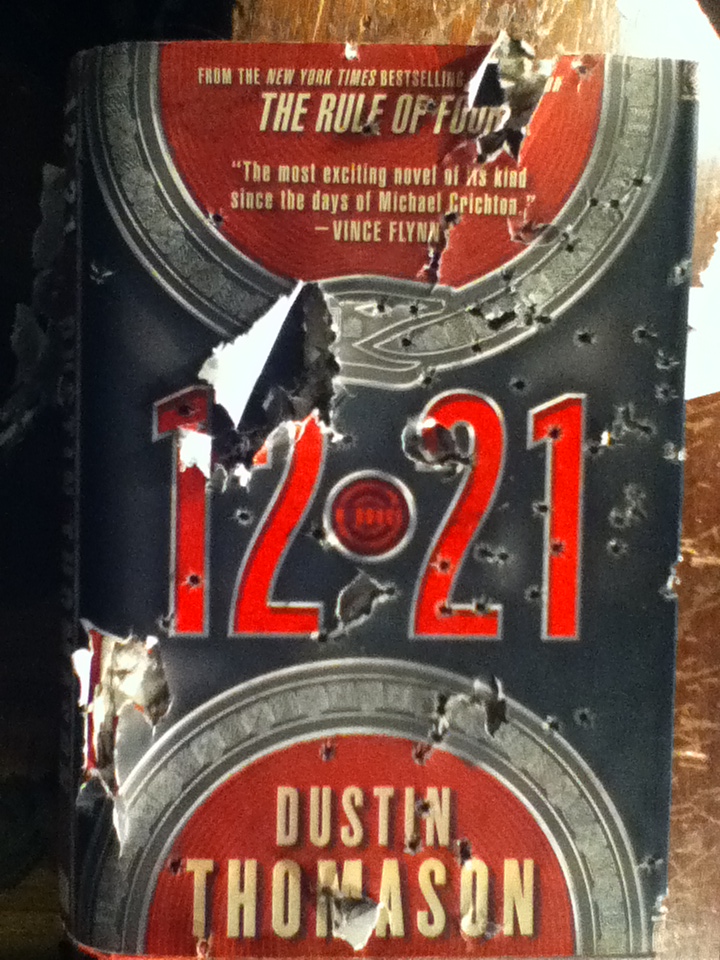
Wednesday, February 6, 2013

Apology for Sciento(symbo)logy


Many people whose taste I respect and opinions I value are nonplussed by my participation in a critical enterprise dedicated exclusively to what they consider superfluous cultural excreta.  They consider symbological fiction to be, at best, indicative of phenomena which, they seem to think, are apprehensible by more elevated means.  "Why do you need to read a Dan Brown book - and not just read it, but read it closely, with annotations, even multiple times, in order to delineate certain operations of the culture industry, or ideology, or whatever you want to call it?" they ask.  "Can't you get all that from Adorno?  Isn't that more fun?"  Until I gave the whole thing up as essentially futile, I tried to persuade them that the consensus that books like this are to be read, if at all, then quickly and superficially - say, on a plane - is no accident.  In vain I remonstrated that their apparent vapidity is precisely what enables their subterranean functionality.  Open the black box of symbology, I said, and you will find illuminating assemblages.  My words fell on deaf ears.

This latest sortie in my apparently incomprehensible and Quixotic campaign can only make things worse.  My only consolation is in my fellow-travellers, one of whom gave me the "Review Copy" of L. Ron Hubbard's Under the Black Ensign to which the next few posts will be dedicated.  Another gave me my first copy of Battlefield Earth, which spurred a similarly doomed adventure.  (All traces of that foray have now been erased from the server, presumably after a "Cease and Desist" suit filed by some Scientologist lawyer.)  I hope these colleagues will not join the ranks of my alienated friends if I insist that we engage, at least briefly, with the only writer of ephemeral fiction to undergo full apotheosis.  Even if he cannot, strictly, be called a symbologist, I hope we will derive further insights from applying to his work the dictum to which (as I have argued elsewhere) the methodologic insights of Freud, Levi-Strauss, and Foucault can be reduced, namely, that if something or someone just looks stupid, you're not looking hard enough.

Friday, September 7, 2012

"Il n'y a pas de hors-VED": Further Remarks on Alterity and its Containment

This post is intended less as an elaboration of any new claims than as a continuation/amplification of some of the points just made by Dr. Prandleforth, as well as some of my own earlier arguments.

Let me begin where Prandleforth ended, with some observations that I hope will clarify and specify the claims I have made in my two posts (here and here) dedicated to delineating VED as it appears as the fundamental a priori substrate of all possible symbological cultural production.
                                                     Fig. 1: vulgarized homo economicus

Clearly, VED names both way of thinking about the subject and a way of talking about the subject's relation to any object.  To adopt and endorse the term Prandleforth has just helpfully given a central place our blog's lexicon, VED may be described as a discourse that, by definition, entails the absorption of alterity into identity, both in terms of the subject and of the object.  How?  By way of what we might call the Regime of Equivalence, and by equivalence, I mean more or less what Marx meant by "exchange value."  The resolution of all imaginable objects into the generalized grid of exchange values by VED implies their basic ontological identity; no object is a priori imaginable that cannot be placed within this regime.  The subject of VED, to repeat a point made elsewhere, is simply (a vulgarized) homo economicus as defined by classical economics, that self-transparent calculating-acquisitive instrument.  To the extent that the subject of VED possesses an existence beyond the goal of calculating acquisition, he is simply the dealer of the commodity of his own labor (the object-dimension of himself) as a commodity in exchange for wages that can be invested in other commodities, all to the end of maximizing calculating-acquisitive gain.

I say all this by way of rendering more precise what is meant by "alterity" in this context, which can only be defined initially, from the point of view of VED, apophatically: anything would qualify as "alterity" as long as it presents itself to experience as something irreducible to the Regime of Equivalence imposed by VED.  Here we are also in territory already trodden by Marx (for one): for him, capitalism can only exist by way of a constitutive denial of alterity, a denial that appears simultaneously in two complementary manners, as fetishism, and as alienation.  Fetishism is the way this denial appears in relation to the object, since it involves treating the object's exchange value as its essential property, and precisely by doing so concealing its actual essential property as the product of labor; alienation is the was that this denial appears in relation to the subject, since it involves resolving the Gattungswesen of the human being (viz. sensuous, transformative labor, in constant creative interaction with the alterity of the object) into the Regime of Equivalence, once again, by reducing it to an exchange value to be traded for wages, which are then used to purchase fetishized objects of consumption, etc.

"The pure products of America go crazy!" proclaimed William Carlos Williams in "For Elsie."  To be extremely simplistic and reductive, something much like this "going crazy" is what seems to mark off Late Capitalism (the era we share with the symbolgists) from High Capitalism (the era of Marx and Piazzi Smyth).  In simple terms, the Regime of Equivalence, along with the various grand narratives that constituted its concrete narrative-ideological supplements became threatened by many tendencies and currents, which we need not go into now.  The point is that the "denial of alterity" as delineated in the previous paragraph became, as the twentieth century progressed, essentially impossible to sustain except through a kind of madness that could barely disguise itself; and yet the Regime of Equivalence became more and more widely accepted as the only conceivable way of imagining the world - hence the Washington Consensus, neoliberalism, etc, thus rendering the thinking of alterity even more "impossible" than before.  Postmodernism is the cultural manifestation of this phase: it renders a world in which "alterity" - i.e. phenomena that seem to threaten the Regime of Equivalence from without - are everywhere, and everywhere "crazy," and yet nothing outside of VED is imaginable in any full sense.  It is in this sense that symbology is both anti-postmodern and postmodern: as I have suggested in a previous post, its primary function is to perform, narratively, imaginary solutions to the conundrums of a world in which VED is impossible to sustain but its imperative to evaporate alterity still reigns.

There are three specific loci of potential alterity that symbological narrative sets out to domesticate in particular, for the benefit of what I have elsewhere called the "wired subject of late technocapitalism" (whose two alternating poles are the Subject of Symbology and the Subject of Fun): 1) The past; 2) The Orient (closely related to 1; see Said, 1978: passim); 3) humanistic scholarship.  Why, you might ask, is it necessary to domesticate these things, all of them so nicely domesticated for us in the era of High Capitalism?  To answer this challenging question as simply as possible, I will simply refer the reader to the Lyotard's 1979 account of the decline of Grand Narratives as a fundamental condition of postmodernism.  

                                                             Fig. 2: Grand Narrative

Yet we need to render Lyotard's notion more precise.  He (and other observers in the 70s) underestimated the resilience of the grand narratives pertaining to the natural sciences: hence practically everything Dawkins says would be fully recognizable by a nineteenth century positivist, the neuroscientific conquest of human nature is a recapitulation of phrenology, Sam Harris's supposedly groundbreaking effort at elaborating a scientific basis for morality is a repackaging of boilerplate utilitarianism, etc.  This is, as we have discussed before, why the Scientist in symbological fiction invariably occupies an unproblematic role in relation to the Code: alterity cannot be threatening to the Scientist because [s]he [and gender neutrality is important here given the emprirical facts of the symbological corpus] is permanently subsumed in the Regime of Equivalence posited by VED.  But the decline of grand narratives sufficient for subsuming the past (via teleology), the Orient (via colonialism, overtly expressed racism and ethnocentrism, etc.), and humanistic scholarship (via several routes, one being the various attempts at positivist mimicry of the natural sciences, another being various notions of humanizing pedagogy, i.e. bourgeois subject formation, training in Bourdieuvian "distinction," etc), is unquestionably a reality, and it is to this reality in part that symbology responds.

                                                 Fig. 3: Grand Narrative in decline

Prandleforth's contribution has refocused our attention, by way of a valuable consideration of Thomason's use of the Museum of Jurassic Technology, on a related locus of alterity that must form part of our considerations: postmodernism/postmodernity.  It seems important to specify the precise content of the latter formation that the symbological novel, along with most or all mainstream cultural products, seizes on: relativism, which we might characterize as an attitude of bewildered embarrassment regarding 1 and 2 (see above) particularly widespread in the milieu dedicated to 3, generated by the disappearance of the grand narratives described in the previous paragraph.  Now note that relativism is in reality a kind of preservation of the Regime of Equivalence on the cheap, so to speak, but that it appears to the more rigidly contained subject of VED as a disturbing gateway drug on the slippery slope to alterity (to use an ugly mixed metaphor fully appropriate to symbological discourse), in so far as it renders the paroxystic state of the denizen of late techno-capitalism all too palpable.

At this point I would like to take us on a brief detour through Michael Taussig's delightful The Devil and Commodity Fetishism in South America, a book that is half an ethnography of two of the most intensive export commodity-producing realms of South America (the sugar plantations of Colombia's Cauca Valley and the mines of highland Bolivia) and half an elaboration of the theoretical contributions of folk demonology to the critique of capitalism.  Taussig argues that when confronted with the specific alterity of the capitalist model of production and the incentives, forms of relation to work and to fellows, and attitudes towards objects it entails, the denizens of kinship-structured societies who practice exchange primarily through gift and open credit cannot but interpret wage labor as a kind of demonic pact, since it involves the relinquishing of the entire range of relations and activities associated with fertility and community in favor of a set of relations and practices associated with sterility and isolation, in exchange for a form of acquisition that appears obscene and uncanny because of its impersonality.  How does Taussig help us here?  I would like to suggest that the purpose of our enterprise is to treat symbology in its broadest sense as a document of folk beliefs that in a sense mirror those of the Colombian and Bolivian peasants.  The latter developed their demonology out of a need to represent VED to themselves within their own system of representations and values; symbological discourse is likewise a manifestation and reinforcing mechanism of a system of folk beliefs that adherents of VED have developed to represent various phenomena that seem to present a disturbing alterity.  It, too, imagines a kind of demonic pact (see fig. 2 in Prandleforth's post below): that is, cacognosis.  

I would now like to consider Prandleforth's statement that "The cacognostic, on the other hand, is an actually transcendent subject, who actually refuses VED."  Now this is of course true, and yet the opposite is also true, insofar as it is at the same time the cacognostic who most closely resembles the vulgarized homo economicus discussed above.  In Reilly's novels, for instance, the endless proliferation of mirror-image cacognostics are all basically avatars of the military industrial complexes of various countries, each seeking geopolitical advantage through the calculating acquisition of valuable objects; Rollins's evil French big pharma magnates are not much different.  In other novels, the cacognostic seeks the Grail, the Benben stones, etc., because he believes they will be the key to unlimited worldly power.  What is strange about this, from the perspective of VED, is simply that he thinks that an exotic historical object, rather than simply capital, will be the key to unlimited power; and yet, he is otherwise represented as seeking said object in much the way that the sometimes idealized, sometimes demonized "cowboy capitalist" of VED pursues profit.  

But note that while the "cowboy capitalist's" way of pursuing profit may be regarded as problematic by some liberals, his motivation is never regarded as questionable or opaque - here is where the cacognostic is his opposite.  What the cacognostic adds to the picture, fundamentally, is an obscene supplement of sado-masochistic corporeal/material enjoyment/jouissance (Malakh, Silas, etc.) which is simply another way of demonizing a kind of fetishization that stands in opposition to but is the grotesque double of commodity fetishism.  This latter proceeds, in a sense, in an opposite manner from fetishism traditionally imagined, that of primitives and Orientals, which crudely fixates on the sensuous materiality of a thing as if it were a divine attribute: commodity fetishism, as per Marx, abstracts and the particular, sensuous materiality of the thing into exchange value, and thus essentially abolishes it.  The cacognostic practices something more like primitive/Oriental fetishism, but does so formally as if he were practicing commodity fetishism.  Thus the representation of alterity in the cacognostic ends up being the self-representation of the vulgar homo economicus himself, in his pathological dimension.  In this regard, the denial of alterity enacted is ultimately a denial of the alterity of the self, that is, of those dimensions of the self that would seem to exceed the articulated logic of VED.   


                                        Fig. 4: the cacognostic as spectral double of the capitalist

Where do the remaining subject positions fit into this picture?  The mythognostic is the insufficiently committed subject of VED, perhaps the relativist in all of us waiting to get out, who needs to be exhorted to acknowledge more resoundingly the self-sufficiency and adequacy of the Regime of Equivalence.  His seduction by the code, and simultaneously by the cacognostic, takes him on a journey that ultimately allows him to reaffirm his VED subjectivity by way of an acknowledgement that the orthognostic is the ideal, i.e. indifférant, subject of VED as he should appear to himself.  The mythognostic's main flaw is his curiosity about the code, which can simply be understood as anything that might appear to deserve an inquisitiveness irreducible to VED motives, and it is precisely this flaw in the presumed reader that symbology sets out to correct.  This, to conclude, is why I am especially troubled when I hear it claimed, in an iteration of symb-pology (B), that Dan Brown is at least getting people interested in scholarship/the humanities/the history of religion who might not otherwise be.  After all, the entire purpose of his "getting them interested" is to evaporate in advance any potential such things might have to trouble such readers.


Wednesday, September 5, 2012

The Metastases of Alterity: Cacognosis in 12.21


Fig 1. How to criticize with an automatic
When the real is no longer what it used to be, nostalgia assumes its full meaning. There is a proliferation of myths of origin and signs of reality; of second-hand truth, objectivity and authenticity. There is an escalation of the true, of the lived experience; a resurrection of the figurative where the object and substance have disappeared. And there is a panic-stricken production of the real and the referential, above and parallel to the panic of material production. This is how simulation appears in the phase that concerns us: a strategy of the real, neo-real and hyperreal, whose universal double is a strategy of deterrence.

Baudrillard, Simulations 
(Taken from Helguera, "Polyvalent Spaces: The Postmodern Wunderkammer and the Return of Ambiguity")

But at last I am going to defy the ban on speech about this thing. Results, I am certain, are so thorough that no public harm save a shock of repulsion could ever accrue from a hinting of what was found by those horrified men... Besides, what was found might possibly have more than one explanation. I do not know just how much of the whole tale has been told even to me, and I have many reasons for not wishing to probe deeper. For my contact with this affair has been closer than that of any other layman, and I have carried away impressions which are yet to drive me to drastic measures.

H.P. Lovecraft, The Shadow Over Innsmouth 


I


One might summarize many previous contributions to this forum, and the unpublished work on which they have been based, by defining the symbological novel as a narrative machine for colonizing alterity with normality which is a late emanation of the European encounter with the New World.  Correspondingly, one might gloss many previous analyses of the positions available to the Symbologist by saying that mythognosis corresponds to awareness of alterity, orthognosis to denial of alterity, and cacognosis to engagement with alterity.  The plot of every symbological novel charts the progression of the Symbologist from mythognosis through cacognosis to redemption by orthognosis, which is to say from incurious awareness of alterity to engagement with its substantive particulars, followed by redemption through a formal repudiation of its Otherness.  (As Twinglebrook-Hastings recently pointed out, this is why they have them in airports.)

I will flesh out this concise schema a little, for the sake of the new readers who, no doubt, flock daily to this blog; I hope the old hands will forgive me.  This is how it works: 

The Symbologist initially regards the Object to which the Code refers as existing, but being of mere academic curiosity (e.g. Langdon's initial attitude to the Illuminati in DVC).  The action of the novel begins when events force the Symbologist to regard the Code and its Object (both of which should be understood to stand for the “Other” in the postcolonial sense) as being of practical importance.  Crucially, these events are always caused by cacognosis, and are typically the personal doing of actually cacognostic characters.  It is engagement with alterity, which is to say flirtation with cacognosis, which drives the mythognostic Symbologist from his accustomed indifférance.  For example, in TLS (as Bremselhacker has noted,) all of  the arch-cacognostic Mal’Akh’s activities constitute a performance whose only conceivable audience is the Symbologist, and whose sole object is to convince the Symbologist of its own relevance.  Langdon's intrigue actually generates each subsequent performances, exacerbating the eruption of cacognosis.  

In all symbological novels, the unraveling of the Code prompted by the supervention of alterity (i.e., cacognosis,) leads to one of two possible conclusions
  1. The Object is a source of dangerous alterity.  In this case, it is invariably destroyed.  This is common in the Reillyan vein of symbologic fiction, and has also been observed by Twinglebrook-Hastings in Brown’s pre-symbological work Deception Point.
  2. The Object turns out not to be a source of dangerous alterity, but to have been misinterpreted as such by the cacognostic (typically because he “took it literally”).  Instead, it turns out to be a metaphorical representation of some commonplace feature of the Symbologist’s ideological landscape.  This is the usual conclusion of classical symbologic novels (e.g. PYR, DVC, TLS, TGK).

Strategy #2 is, as Simon Schaffer has brilliantly demonstrated in his Tarner Lecture "An Antique Land," has its origins in the colonial literature of the late 18th and early 19th centuries, which persistently sought to characterize colonization as a form of return by locating the precursors of the colonists’ greatest achievements (e.g. meridian astronomy) in the immemorial past of the colonized people.  It is also widely observable in other contemporary cultural products such as von Daniken/Tsoukalos’ History Channel series Ancient Aliens and neurosymbological works like James Cameron’s Avatar. 

Fig 2. Cacognosis
The progression of the Symbologist through a series of relations to alterity is the backbone of the symbological novel, and is analogous in its strict formality and propaedeutic intent to the Medieval morality play.  It is on this basis that symbological fiction generally has been characterized as a reaction to postmodernity, broadly understood to include all manifestations of postcolonialism and poststructuralism, those Hellmouths which endlessly unleash coruscating swarms of alterities.  Within Symbologist's renunciation of the postmodern condition, cacognosis plays the role of the Devil in the Temptation of Christ (Matt 4:1-10): it is the force which tempts the Symbologist from the path of righteousness, and its rejection constitutes his redemption.

This functional characterization of cacognosis does not exhaust the subject, but is essential to a close reading of 12.21; the novel lacks a cacognostic character in the usual sense, but cacognosis plays its usual role nothetheless.  

Thomason has only one important cacognostic character, Chel’s mentor and surrogate father Victor Cranning.  Unlike Mal’Akh, Teabing, Bezumov, Senator Kurtz, or any of the other cacognostics familiar from the classics of the genre, Cranning is very nearly irrelevant to the plot; he does not set its events in motion personally, nor does he have have the usual cat-and-mouse relation to the Symbologist.  It is not his activity which motivates the transition from awareness to engagement for Chel or Stanton.  However, as St. Basil tells us, "by this silence, history wishes to train the activity or our intelligence, giving it a weak point for starting, to impel it to the discovery of the truth" (Hexaemeron 1:3).  Cranning is a tiny piece of flotsam whose course allows us to deduce the direction of the great whorl of cacognosis.

2

Cranning trains the activity of our intelligence in two important respects, one direct; the other indirect.

First, he directly confirms that cacognosis tout court is to be identified with postmodernity.  We initially encounter him in what Pablo Helguera calls a "postmodern Wunderkammer:" the Museum of Jurassic Technology, which is described (by Thomason) as follows:

The Museum intentionally obscured the lines between fact and fiction.  Part of the fun was trying to figure out which exhibits were real.  Still, Chel was philosophically ambivalent about a place that inspired concusion and defied logic.  Not to mention how uncomfortable she was with the exhibit her old mentor was putting up there. (123).

The exhibit turns out to be a representation of the four races of man allegedly described in Mayan cosmology.  Its fixation with indexical, immediate relations of signification (each piece is a sculpture of the human form in the medium allocated by Mayan cosmology to the respective race of man, e.g. corn, chicken bones, etc.) is instantly reminiscent of the logic of spirit animal assignation Thomas imputes to contemporary Guatemalan peasants:
A man’s wayob was a symbol of who he was: the brave man, like a king, was a jaguar; the funny man, a howler monkey; the slow man, a turtle. (72)
Cranning's work is, to filch a Hesperidean apple from the garden of Brown himself, "symbologically perfect": it refuses all forms of signification other than the indexical, and its referents belong to autochthonous myth.  However, the point is clearly that despite it’s symologic orthodoxy, Cranning’s exhibit qua engagement with the Other is cacognosis and therefore belongs in a sanctum of postmodernity which “intentionally obscured the lines between fact and fiction."  It is precisely because Cranning seeks to understand (which in symbological fiction means also “to emulate”) the Other that he counts as postmodern, and cacognostic.

Fig 3. Alleged physician; total douchebag.
The second, sense in which Cranning trains our intelligence is indirect, for the primary manifestation of cacognosis in 12.21 is not Cranning personally, but rather the the plague itself, Thomason’s stupid, fictitious prion disease “VFI.”  VFI is, in fact, so stupid in its particulars, that its invention by someone who claims at some point to have attended a medical school somewhere must signal a deliberate allegory in which the signifier is writing checks the referent cannot honor.  And indeed, if we attend to the morphology and functionality of VFI, we discover some salient facts supporting this deduction: 

First, VFI is acquired by contact with the Code (in this case, the codex); crucially, it is only acquired by cacognostic contact with the code.  Chel’s orthognostic uncle found the hidden city, but was spared because his only motivation was nationalist pride and respect for is ancestors.  On the other hand, Volcy, who “let the white man’s obsession with the Long Count compel him to sacrifice the honor of his ancestors” (76, read: “let the white man’s engagement with his alterity compel him to tempt them with it) is afflicted.  According to the strict constraints of the symbological novel, the Symbologist is the only subject; all other characters are allegorical representations, so the only possibility for an orthognostic, like Volcy, who flirts with cacognosis is annihilation.  (This is, incidentally, why in novels with a cacognostic character the copout always results in the cacognostic's death, and why that death is nearly always an act of nature rather than of any other character.  For the cacognostic to survive the copout, he would have to change his relation to alterity, which is only possible for the Symbologist.)

Fig. 4. The workings of ideology made visible.
Second, the plague, like cacognosis, is transmitted by the organs of vision and causes fatal insomnia.  One need hardly point out that this is a precise reversal of John Carpenter’s acerbic critique of ideology in the film They Live, which imagines a universe where magical sunglasses make ideology visible and stop subjects from functioning "all by themselves." Thomason instead enjoins us to don "eye covers" when faced with the Other, and prove our sanity by our ability to sleep.  

Third, the equation of VFI with cacognosis is confirmed by the means of its control.  Early on, Thomason says that "LAPD had been called in to stop the metastasizing press."  This seems a bizarre metaphor, particularly for an alleged doctor, until juxtaposed with the only other reference to metastasis in 12.21: 
It's like a cancer.  Even if it's metastasized, you remove the tumor at its original site so it doesn't spread further.  We need to know what it is and how it started to have any chance of fighting it. (121)
This is, of course, true neither of cancer nor of prion disease, but it is true of cacognosis, as is roundly demonstrated by every other symbological novel; the redemption of the Symbologist always consists in locating the source of cacognosis (which is typically seated in an individual like Mal'Akh, Teabing, or Bezumov,) and extirpating it by one of the two means described above.

Fig 5. Cacognosis.
The answers to Stanton's two questions, i.e. "what it is" and "how it started" provide the final proof of the equation of cacognosis with alterity.  As I think I've demonstrated, what VFI is is cacognosis.  Where it started is a little more complex: its proximal cause is cannibalism (that perennial symbol of cultural alterity, ascribed at various times to basically everyone encountered by Europeans leaving Europe over the last five hundred years); but its ultimate cause, as Volcy explicitly tells us, is the cacognosis of people like Victor Cranning. 

3

This line of enquiry leads to the final question I will attempt to answer in this post, which concerns the role of what we have been calling "vulgar economic determinism" in 12.21.  In the (now lamentably remote) last post on this blog, Bremselhacker gave a compelling account of the complementary means by which classical ("strong") symbology and para-symbological discourses such as David Brooks saccharine and obnoxious neurosymbology ("weak symbology") serve to re-contain the Symbologist (and the reader) as subjects constituted strictly by the pedestrian ideology of modern techno-capitalism.  

The entire essay rewards re-reading, but the element I wish to build on here is his claim that in strong symbology, the suspension of VED as the sole conceivable basis for human behavior renders the mythognostic Symbologist opaque to himself because it ostends the possibility of a transcendent subjectivity.  Once Langdon begins to believe in the possibility that the Grail exists, it "changes everything," and causes him to ask whether "you realize the implications this could have?!"  This moment is exactly coincident with the appearance of cacognosis, which is to say, alterity.  That is because they are the same narrative gesture.   

(As an aside, this ontologic failure of self-transparency is impossible in weak symbology, because the economy of truth is different in that "science" is never called into question; the subject of weak symbology is not self-transparent, but his recovery consists in discovering that science has accounted or his non-transparency by proving the phenomenologic monotony of VED).

What Thomason's awful book allows us to see, then, is the true nature of cacognosis.  In strong symbology, the mythognostic Symbologist is tempted by the possibility of a transcendant subjectivity (i.e., one which transcends VED) but redeemed by the revelation that the signs of the Other were only metaphors for the himself (i.e., VED).  The cacognostic, on the other hand, is an actually transcendent subject, who actually refuses VED.  (This is why cacognosis is always Orientalized.)  Examples abound, from Silas' asceticism to Mal'akh's tattoos, but the purest example I can call to mind is Victor Cranning, whose animating goal is to obtain the priceless commodity, remove it from the circuits of capital, and remove himself from society in order to enact a radical alternative to the present order.

And what, exactly, is the transcendent possibility represented by cacognosis?  This is precisely the point: you, the reader, and he, the Symbologist, can never know, because to tell you would subvert the entire function of symbological narrative.  The cacognostic cannot speak.   This is why Martin's Ahmed Aziz, and, for that matter, Chel and Stanton, cannot even parrot existing orthodoxy in their disciplines.  To do so would contravene the necessity of preserving, as Twinglebrook-Hastings has put it, "the existing order of things that the symbological narrative functions to maintain while absorbing anything subversive."  Even actually existing academic consensus represents a tentacle of the alterity, the suppression of which is the primary histologic commitment of the symbological novel.  

So, in the end, Thomason leaves one feeling a bit like Odin.  Reading his second and, (pray God) final offering may be phenomenologically indistinguishable from having one's eye gouged out; but the prize of knowledge demands sacrifice.

Tuesday, January 18, 2011

"Sie wissen es, und sie tun es": How to stop worrying and love VED


In light of the promising strides we have taken of late toward a synthetic grammar encompassing the characteristic operations common to classical symbological narrative, "weak" symbological narrative, and neurosymb(-p)ological discourse, I would like to propose a formula whose resemblance to what Prandleforth recently identified as "the main aporia of neurosymbology" will be obvious. I will call this the First Antinomy of Symb(-p)ological Reason, and phrase it as follows:

Thesis
: The predictive models of behavior permitted by the presumption of VED as the basic substrate of human motivation render the subject transparent to himself* and to others.
Antithesis: The presumption of VED as the mechanism underlying all human behavior implies a concealed substrate unavailable to the subject through through mere introspection or observation of the phenomenal stratum of his behavior. Therefore, it renders the subject no longer transparent to himself.

In other words, VED is universally used, across the political spectrum, as the basis of policy arguments and marketing strategies alike, and provides the unquestioned basis of most pop sociology and economics. It is therefore understood to provide and widely accepted as providing a sufficient account of human experience and motivation, and in certain spheres this is acknowledged publicly and openly with no apparent discomfort or shame. On the other hand, VED appears in many areas of discourse as a crafty secret sharer, providing the dark, unacknowledged truth of our actions, altruistic or unselfish as they may seem. For example, opponents of everything from vaccines to abortion tend to impute VED motives to their purveyors in order to unmask the secret, craven motives underlying their participation in an allegedly sinister practice. The resonance of such arguments, as indicated by their prevalence, suggests that VED requires a logic of supplementarity: it is taken by the collective social imaginary as as both sufficient and complete, and in need of a supplement, which would be identical with precisely that which is absent in the motives of those we stigmatize with the accusation of VED, even as we unquestioningly proceed as though we assume VED as the unproblematic explanans of all behavior.

At this point, I would like to pause and preface my further considerations with the following hypothesis: symb(-p)ological discourse consists in the elaboration of imaginary resolutions of the aporia deriving from the First Antinomy.

David Brooks's hot-off-the-press essay "Social Animal" provides us with a helpfully succinct illustration of the operation I am attempting to map out. Since Prandleforth has already provided us with an incisive rhetorical analysis of this veritable concrete universal of neurosymb(-p)ological discourse, I would only like to add the following: Brooks's early twenty-first century bourgeois everyman, Harold, recognizes himself as the subject of VED, understands his motives to be fully transparent to introspection, and is distressed by the resulting sense of being "shallower than [he] need[s] to be" because he perceives acquisition of wealth and consumption as the be all and end all of his existence qua homo economicus. "His superhuman equilibrium is marred by an anxiety" because he "is inarticulate about the things that matter most." This is precisely the scenario that demands, here as throughout the body of discourse whose many forms we have been characterizing on this blog, what we might call the symbological supplement: the unveiling of an allegedly previously concealed realm of values, experiences, and motivations that, in fact, result in the reinstatement of the unsatisfactory realm of experience they were supposed to supplant, now understood as necessary and transcendent rather than contingent and accidental. Harold's enlightenment proceeds through the pedagogical project of neuroscience, conceived and presented by Brooks purely in its ideological dimension (that is, what is of value about neuroscience and related areas of research is that they provide the possibility of suturing the gap between the experience of VED as transparency and autonomy and the experience of VED as "shallowness" and mystification). After his conversion at the hands of the motorcycle-riding Russian folk dance enthusiast neuroscientist, Harold can resume being what he has already been. In becoming transparent to himself (through neurosymbology's account of why the things he was doing already constitute the natural and necessary form of his existence, as programmed by evolution and early neurological development), he learns how he may again take satisfaction in his non-transparency to himself (in "situations in which you lose self-consciousness and become fused with other people, experiences, and tasks," a.k.a. late capitalism's endless varieties of consumption). The symbological supplement, then, furnishes the subject of late capitalism with a form of imaginary self-transparency adequate to and consistent with his continued acceptance of the sufficiency and normativity of VED.

A further way of explaining the symbological resolution of the First Antinomy proceeds via Prandleforth's recent narrative analyses of the bifurcation of the subject of late capitalism, as represented and interpellated by symbological discourse, into the "subject of symbology" and the "subject of fun." To summarize Prandleforth's conclusions, the "subject of symbology" is, precisely, the subject of VED conceived as entirely transparent to him- or herself**, while the "subject of fun" is the subject of VED for whom the "fun" consists precisely in a supposed temporary suspension of the imperatives of VED and a concomitant loss of the sense of self-transparency continuous with the assumption of VED. It would be tempting to propose that the subject of symbology stands as the desired product of the interpellation carried out by symbological narrative, that is, it serves as the point of identification for the subject in its attempt to fully assume the superego injunction to enjoy, while the subject of fun serves merely as the vehicle for this operation (and this is certainly an important part of the story, as Prandleforth's most recent posts have suggested); and yet, it is important to emphasize that symb-pological discourse, at least in what I have called its (A) iteration, proceeds in precisely the opposite direction, enjoining the reader/viewer to fully abandon the fantasy of transcendent subjectivity known as Orthognosis (whose underlying identity with the self-transparency of the subject of VED I demonstrated with regard to Avatar), and effectively reassume the position of the "subject of fun" who ceases to require of himself the introspective self-transparency at precisely the point at which he remarks: "who cares about all that New Age/conspiracy theory/dream nonsense, it was a good read/entertaining movie." The point here, though, is that VED is revealed to be the truth of OG, just as OG is revealed to be the truth of VED in a kind of mutual transfiguration nicely concretized in the closing scene of Avatar, in which we witness, as I argued previously, the apotheosis of the "deracinated, 'wired' subject of late technoscientific capitalism" in the form of the Na'vi ritualistic mind-meld.

Now, we have already established elsewhere that the symb-pologist's primary task is to articulate the cop-out's implication of strong irrelevance and oblige the reader to adopt the appropriately indifférant (in other words, "fun-loving") stance. The viewer/reader's resumption of his prior position as subject of fun through narrative identification with the subject of symbology, of course, leaves him conveniently ripe for the consumption of more symbological discourse, in which the structuring dialectic of self-transparency and self-opacity can be rehearsed once again. The foregoing has suggested that this "movement of spirit" can proceed by several different and equally effective paths. If, as we have already asserted previously, weak symbological narrative is distinguished in part by the fact that some explicit form of VED retains an explicit presence in the narrative, it allows the reconciliation of the "subject of fun" (unselfaware subject of VED) with the "subject of symbology" (self-transparent subject of VED) to be accomplished efficiently and with a minimum of risk that the concluding OG position be perceived as anything other than the truth of VED. Strong symbological narrative, on the other hand, enacts a more capacious supplementation of VED in its proliferation of idiotic pseudo-knowledge and therefore achieves a more decisive recontainment at the probably worthwhile cost of an increased risk (hence, it is worth noting, the greater potential for strong symbology to generate symb-pology [B], and the greater necessity for particularly strident statements of symb-pology [A]).

I will close, then with the following propositions:
1) Weak symbology, like most instances of (neuro-)symb-pology, interpellates the subject of symbology through identification with the subject of fun. In other words, it functions by engaging with the supposed introspective self-awareness of the reader/viewer in order to instruct him to enjoy, and presents this "fun"/"immersion directly in the river" as the necessary consequence of the fuller awareness provided by the symbological supplement.
2) Strong symbology interpellates the subject of fun through identification with the subject of symbology. That is to say, the reader/viewer's "fun" consists in his fusion with the fantasy of transcendent subjectivity (distributed in some form along the MGCGOG continuum) pursued in the narrative, a fantasy which he ideally concludes by identifying with the given facts of his existence qua VED subject of late capitalism.
3) These operations are mutually complementary and mutually reinforcing. Indeed, as I believe we are beginning to substantiate, they both form (essential components of) a system of meaning (synchronically) and constitute and deliver forms of experience that require a potentially endless stream of further supplementation via related cultural products drawn from the constellation to which they belong.

In the name of advancing the systematicity of our inquiries, I hope to comment soon on the impressive recent contribution of my colleague Twinglebrook-Hastings to the elaboration of the long-neglected area of paragnosis, particularly in relation to our productive ongoing interrogation of VED.

*I use the masculine pronoun in reference to the subject of fun/symbology advisedly, as the discourse in question makes explicit that the female subject position we have O(f) by definition cannot experience a traumatic gap between her awareness of VED and her assumption of VED. Tom Martin's Kingdom and Julia Navarro's The Bible of Clay are, of course, the most daring treatments to date of the problem of feminine indifférance in symbological discourse.
**On the other hand, I am being gender neutral here because the position O(f) may, in fact, stand in for the subject of symbology qua subject fully transparent to introspection. The O(f), on the other hand, may not respond to the radical gap between this transparency and its concomitant opacity with anything but a sigh of indifférance, and therefore her perspective cannot constitute the point of departure of any symbological discourse (thus, in Kingdom, despite Nancy Kelly's apparent position as protagonist and primary site of readerly identification, I would propose that she must finally be understood as Anton Herzog's symptom [cf. Lacan: "Woman is one of the Names-of-the-Father"]).

Vulgar Economic Determinism and the Subconscious RSA

I want to briefly expand on a few things which were immanent but insufficiently realized in my last post. 

I  realize that I failed adequately to answer Bremselhacker's call for a more thorough analysis of "vulgar economic determinism" (VED) and its relation to "strong" and "weak" symbological narrative, despite some implications of my claims about Nolan's construction of the "subconscious" which in retrospect have rather clear relevance. So let me try to concisely redress that omission by describing strong and weak symbology with reference particularly to the situation of VED in both.

(As an aside, although I believe this is fairly clear from preceding contributions to this forum, it is probably worth saying that by the term VED I understand the content of late capitalist ideology's interpellation of its subjects - i.e, to be a subject of VED is to understand oneself as a generally rational actor most of whose behavior is motivated by the desire for economic gain within a free market economy.)
If we consider Inception and Avatar as examples of weak symbological narrative and contrast them with the stronger forms familiar to us all (Pyramid, The Gaudi Key, Dan Brown's entire oeuvre, etc.) I think a coherent dialectic emerges.  This incorporates the relative presence in the narrative of VED which B'hacker had already pointed out, but also involves the position of the I designated as "S" in my review of Inception and which I agreed with B'hacker is homologous with that of the consumer of symbological narrative (henceforth "the reader").

In strong symbological narrative the reader is absent from the narrative, and VED does not appear explicitly except as a corollary of cacognosis (although classical cacognostics are never solely motivated by VED).  By contrast, VED is given as the default position of the reader, which is suspended by the narrative and re-instated by the cop-out.  For instance, in Pyramid the reader is initially interpellated, via Catherine's conversations with Professor Kent (most noticeably the famous "Electric Juicer Discourse") as in every significant respect a conventional consumer, participating in the circuits of capital as they presently exist in Western Europe and North America.  This position is apparently problematized (by the seemingly impending revelation of information which will fundamentally compromise its basic assumptions) in the body of the novel; but via the denoument (AKA the flagrant cop-out) the bourgeois subjectivity of the protagonists is re-instated having been invested through the drama with a vague air of transcendental significance but unchanged in its particulars.   Catherine Donovan is exactly the same free-range chicken loving, pseudo-environmentalist member of the petite bourgeoisie at end of Pyramid; she just feels a little more spiritual about recycling.  David Brooks offers us a neurosymbological version of this in his recent article, already discussed in this forum, in the biography of his allegorical character "Harold," who returns from a confrontation with the cutting edge of neuroscience newly enabled to decide between different flavors for fru-fru gelato.
By contrast, in weak symbological narrative the reader is foregrounded in the narrative, VED is the primary animating motivation.  In both Avatar and Inception the reader is invoked as neurosymbologically analogous to the subjects of alterior experience - Jake Sully in Avatar and Maurice Fischer in Inception, in the way I described in the previous post. 

Now, what is notable about VED in Inception specifically is that the only character in either the waking or dreaming world who is not solely motivated by VED is Maurice Fischer, who remains in the "S" position for the entire film.  Importantly, it is clearly implied that he is a subject of VED when he does not occupy S, in that he is the heir of the energy dynasty which D/E hope to break up on behalf of Saito.  This corresponds well to our understanding of strong symbological narrative, in that if we are to understand Fischer as analogous to the reader we would expect him to be suspended from determination by VED during the course of his experience of the narrative, in the case, his dream.

Recall that in my previous post I argued that S's subconscious, qua normative regulatory agency, is determined by a logic internal to itself.  This is made evident when Fischer is made to realize that he is dreaming and, rather than being able suddenly to control his "projections," he becomes the object of their aggression.  Based on the foregoing, I advance the hypothesis that the logic of the subconscious in Inception is, very precisely, VED.  This also explains the fact that D/E are characterized by the consubstantiality of their subconscious and conscious minds; they are characters in symbological narrative, and thus they are part of the vocabulary by which VED is expressed.  They can no more contradict it than a word in this sentence can suddenly become Chinese. 

S, on the other hand, stands for an actual interpellated subject capable of construing their worlds in other ways than those prescribed by VED.  And this is precisely what I meant in saying that the subconscious "attempts to make the subject of "fun" more like the subject of symbology."  Maurice Fischer's subconscious is activated by his attempted divergence from VED, and it reconstrains him to its logic by force. 

This allows me to phrase the strong/weak dialectic somewhat more concisely.  Strong symbological narrative backgrounds both the reader and VED in order to undertake the ideological operation whereby the subject is re-consolidated in the complex of "obviousnesses," which was apparently suspended during the action of the narrative, by means of the cop-out, i.e. ideological re-containment.  Weak symbological narrative foregrounds both the reader and VED in order to dramatize the operation of ideological re-containment.  Strong symbology enacts the reader's re-containment ot VED; weak symbology narrates that operation to the reader.

Monday, January 17, 2011

Paragnosis Unbound (1)

Unicorns are Real and So Are Postmodern Nihilist Academics

It's difficult to convince our colleagues across the hall in the Serious Business department that they should read Dan Brown in order to better understand themselves and their fellows, but that's what we're saying. The popularity of The Da Vinci Code, its imitations, precursors and prefigurations should be enough to convince everyone that these novels answer to some need that is deeper than the sterile explanation that it is fun, entertaining or the like. When these pseudo-explanations are not obfuscations covering the contents and effects of these books they merely push the question about the existence of these books back to the point where we have to ask ourselves why this particular type of novel is so fun, so entertaining. Why? Why mere fun? Once you drink the Kool-Aid of the critique of symbology you discover first that Dan Brown's novels are representatives of an extremely widely disseminated type we call the symbological novel, the variations of which are both systematic and extremely common. (So common in fact that they stretch out of the airport bookshop and into New-York-Times-style literary criticism and writing about neuroscience and evolutionary biology.)

The statement about the type of story of which The Da Vinci Code is an instance is its generative grammar. The grammar describes the basic attitudes in the narrative toward signs, their referents and their significance for the characters and the world of the novel. As originally formulated by the illustríous and learnéd Dr Bremselhäcker, the generative grammar of the symbological novel looks lika dees:


The labels on the left name character types (subject positions) most famously exemplified by the unappetizing Robert Langdon, who begins every novel sure in the belief that while the symbols he studies refer to real things, places, sects and events, these have no real historical significance except as curiosities or "academic" matters. In the terms of the grid, this means that he believes that the ontology of the symbolic is literal (L), but that it's of epistemologically metaphorical (M). E.g., the holy grail is a real thing in the world, but it's of no real cultural, personal or political significance.

The villains of the symbological novel are generally cacognostics: they believe both that signs point to real things and that knowledge of these signs are relevant. The cacognostic is therefore concerned both with locating what the symbol refers to and controlling it. The action of the basic instance of the Brownian symbological novel surrounds the transformation of the mythognostic into the orthognostic. The orthognostic doesn't believe that it matters whether the things, institutions, conspiracies and people referred to by the symbols that decorate these novels exist or not (metaphorical ontology), nor that the symbols have any serious political, religious or personal significance (metaphorical epistemology). Thus however vast the conspiracy or shocking the revelations about the secret history of the world, every novel ends with the casual reaffirmation of the political and cultural status quo. Being an orthognostic means that nothing really needs to change so we can all go back to work.

Much of our literary-critical fate as detailed in this blog has consisted in filling out our symbological bestiary by identifying novels that are variations of this type. E.g., Matthew Reilly's horrible novels of perpetual cacognosis or Coelho's placid tales of eternal orthognosis. What varies from story to story and movie to movie is what aspects of the status quo appear to be undermined by the book before being confidently reaffirmed (so-called ideological recontainment), what types of subject position are transforming into what and how the various subject positions in the novels are related. Along the way deep and disturbing connections emerged between the symbological novel and colonial Orientalism (as understood by Said), bad science, what was once so delightfully called the military-industrial complex (as though perhaps it were a psychiatric condition) and Ameircan religion.


The astute reader will notice however that the grid as it appears above is not quite complete. The fourth possible subject position in the generative grammar, formerly called awkwardly but accurately Judith-Butler-gnosis and now called paragnosis lacked a novel detailing its exploits. Ladies and gentlemen, the wait for this symbological unicorn is fucking over. Meet Guillermo Martínez's wretched novel of mathematical intrigue, The Oxford Murders (2006) and the even worse deadly movie adaptation by the same title (2008) starring John Hurt and Elijah Wood and directed by the villainous Álex de la Iglesia. The Oxford Murders (henceforth ToM) is the story of a young Argentinian mathematician named Martin who gets caught up in a series of murders that he and the police believe are the work of a serial killer. Each murder is announced as it happens by a note with the time of the murder and a symbol and are we are led to believe delivered to the eminent logician Arthur Seldom, but which are in fact manufactured by Seldom in order to cover up the murder by his spiritual daughter Beth of her doddering old grandmother.
Title page of Martínez's literary abortion. Fans of this blog, Umberto Eco novels and the works of Tom Martin will note that Guillermo is obviously the shadow of Tom Martin, the object-cause of this author's desire, whose majestically and perhaps willfully bad novel Pyramid was the occasion for our collective descent into the literary-critical and metaphysical abyss. Pyramid is a crummy imitation of The Da Vinci Code, which I suppose just proves The Oxford Murders' claim that "repetition leads to desire, and desire leads to obsession." (p. 179)
An Introduction to Paragnosis

Paragnosis was originally referred to as Judith-Butler-gnosis as a sort of nasty joke. The subject position within the generative grammar has an epistemological that believes that the code is meaningful but that its referents in the world are unimportant or arbitrary. What kind of a lunatic thinks only what we say and think matters and nothing else? Why, none other than the academic. Thus as Bremselhäcker has revealed to us through gritted teeth, within his Comparative Literature department at Important University at New England the default critical position of his colleagues is that culture has primacy over biological and physical facts. They would probably not admit this at the doctor, but in their professional lives they act as though for example sex were completely determined by gender. Whoever doubts the seriousness and pervasiveness of this and similar propositions has never attended a LGBT meeting at a liberal arts college or major metropolitan center. Within such groups it is often taken for granted that either sex is ultimately irrelevant with respect to gender, which can be either performed for the on the fly adoption of a different or even novel gender. Failing that, a utopian reliance on the transcendence of biomedicine insures that the body may be reinterpreted surgically.

N.B. To any upstanding young queer theorists reading. The point is not to acquiesce to hegemonic sexual identities, but rather not to underestimate the profoundly complex and mutually determining interactions between individuals, their cultural environments and their biology. We take it that a good deal of theory does this, to say nothing of people's struggles in their civilian lives. What struck us  about the paragnostic position within the generative grammar is that very bad books like The Da Vinci Code which purport to describe the exploits of academics imply another kind of academic, or at least a parody of one, the post-structuralist, postmodern, signifier-obsessed, Francophiliac deconstructionist. This paragnostic is the mirror image of the mythgnositic hero of Dan Brown's novels. While Robert Langdon believes that his symbols refer to real things, his study of them is "merely academic" and so cannot possibly have any serious impact on the world. The tour of the mythognostic hero in the classical symbological novel is one that leads him to entertain briefly the notion that cultural codes might be of cultural significance before settling on the pacific and vapid conclusion that there really aren't any secret societies of any concern and that, in fact, his academic knowledge is unimportant enough than he can retire to Harvard. The paragnostic as exemplified by Seldom begins with the converse belief. He is convinced of the significance of signs, but they are merely arbitrarily arranged and do not have any bearing on the real world.

Let us go to the scene of this nihilistic pseudo-logic. In ToM the academic authority that wears the costume of Seldom's views is Ludwig Wittgenstein. The actual relation of the philosophical gibberish in book and movie to Wittgenstein's actual views is at best tenuous and will perhaps be taken up later, however Seldom likes to dramatically invoke the closing words of Wittgenstein's first major work the Tractatus Logico-Philosophicus, the doctrine of which is that we can't talk about anything really, most especially truth.

John Hurts my feelings with third-hand pseudo-Wittgenstein. Note that holding up the TLP in this matter is in fact a perfect performance of his epistemology since it is the book as signifier that matters insofar as it's capable of his coercing his students into adopting his views, while its contents are completely irrelevant.

[Seldom stands before a transfixed mob of young Oxonians.]
Seldom: There is no way of finding a single absolute truth, an irrefutable argument to help answer the questions of mankind. Philosophy therefore is dead. Because whereof we cannot speak, thereof we must be silent.
[Dramatic silence. Seldom paces the room. Martin raises his hand.]
Seldom [mockingly]: ooooo! it seems that someone does wish to speak! It appears that you're not in agreement with Wittgenstein. That means either you have found a contradiction in the argument of the Tractatus or you have an absolute truth to share with us all.
Martin: I believe in the number π!
[The crowd laughs.]
Seldom: I'm sorry I didn't understand you. What was it you said you believed in?
Martin: In the number π! In the golden section! The Fibonacci series. The essence of nature is mathematical. There is a hidden meaning beneath reality. Things are organized following a model, a scheme, a logical series. Even the tiny snowflake includes a numerical basis in its structure. Therefore, if we manage to discover the secret meaning of numbers we will know the secret meaning of reality.
This awful little speech could belong to nothing other than a cacognostic. Martin believes that mathematics refers to actually existing entities in the world and that mathematical signs grant power over that world. It is for this reason that he is so eager to hunt down the serial killer that Seldom feeds him signs of. It is interesting to note here that insofar as the paragnostic narrative is concerned, mathematical Platonism of Martin's type coincides rather neatly with conspiracy theory numerology. The meaning of numbers is a secret, relevant to human affairs and waiting to be discovered all around us. Seldom, master manipulator of the sign, will disabuse him of this notion in the course of leading him on a wild goose chase for the serial killer that is supposedly feeding them clues to his next murder. For the moment, however, let us return to the scene of this idiotic battle between paragnosis and cacognosis, realism and constructivism.

Seldom: Impressive! ... We find ourselves faced with a fresh, rousing defense of mathematics, as if numbers were preexisting ideas in reality! Anyway, this is nothing new. Since man is incapable of reconciling mind and matter he tends to confer some sort of entity on ideas because he cannot bear the notion that the purely abstract only exists in our brain. The beauty and harmony of a snowflake. How sweet! The butterfly that flutters its wings and causes a hurricane on the other side of the world. We've been hearing about that damn butterfly for decades! But who has been able to predict a single hurricane?! Nobody!

To which the viewer is perhaps tempted to answer, Well, lots of people. We call them "meteorologists." But this would be to send us off course as much a dwelling on the actual philosophy of Wittgenstein. The point as always is not whether or not these books and movies have the facts straight but the way in which their mangling of the facts represents a certain kind of attitude toward the world.

Seldom quite clearly does not think that numbers and in fact signs generally refer to real things. Martin appears to be some kind of straightforward Platonist about mathematics and signs generally, so it should strike us as odd that Seldom characterizes this position with a hackneyed example from chaos theory. While systems sensitive to initial conditions (like weather systems) might be hard to know about they are not in principle unknowable. This example of Seldom's epistemology will come back to haunt Martin. In the novel, Seldom is painfully explicit about the extent to which nothing can be known via signs.
The series 2, 4, 8, can be continued with the number 16, but also with the number 10, or 2007. You can always find a justification, a rule, that lets you use any number as the fourth term in the series. Any number, any continuation. (65)
Not even context, pattern and a rule describing the continuation of a pattern is sufficient to license knowledge of the next term in a series because it's always possible to invent a rule justifying any next term. To quote Simon Schaffer, "You say '2,4,6,8,10.' We say '2,4,6,8, who do we appreciate!'"

Over the course of the novel Martin will be brought out of his cacognosis and into a kind of paragnosis. I will detail this fate in a coming post. I will close this post with an alarming figure from the novel, our lives, our novels and the British National Symbolic.

The Victory of Paragnosis, or, The Badger Vanishes


As the natural sign of the sign as such, the badger is a clear choice when you want to playfully figure the endless disappearance of the Transcendental Signified over the horizon of meaning. Throughout  the novel (this sequence is sadly missing from the movie) Martin encounters a series of dead badgers, symbols left there for the likes of us. Martin describes his first encounter with the beast, run over on the road.
I’d never seen such an animal before. It looked like a type of giant rat but with a short tail, around which lay a pool of blood. Its head had been totally crushed, but the black snout remained. Where its belly had once been, the unmistakable bulge of what must have been its offspring protruded as if from a torn sack. (76)
Later he encounters it again and a native informant explains that the superstitious British road workers refuse to touch dead badgers. Then a third time in an extreme state of decay before, after Seldom's deception is revealed, the badger disappears completely. The series of signs, the code woven by Seldom out of nothing but references to itself, covers in the end nothing. There is no serial killer. The conspiracy is a plot laid by one man to cover the fact that there is no conspiracy. The appearance of a conspiracy is only a product of a series of signs that ultimately point to nothing but the more or less ordinary passions, crimes and selfish deeds of ordinary subjects.
I looked down but could see no sign of the badger. The last shred of flesh had disappeared, as far as the eye could see, the road stretching ahead of me was clean, clear, innocent once more. (197)
The victory of paragnosis, a hyperbolic perversion of poststructuralism, is encoded here in the text of The Oxford Murders. It is difficult not to read this erasure of the badger as a figure of what we've come to call the entropy of mythognosis, a basic premise of symbological historiography. All referents fade into the past and our access to them is speculative at best. This specific figuration of the status of the signifier is, however, deeply disturbing and undoubtedly points to a vast conspiracy theory within the publishing industry aimed directly at the authors of this blog. (Why not a dog? Why not a blood stain? Why a badger?)

Here gentle reader you must take my hand as I reveal to you secret texts, unpublished and unpublishable. In the following fictional recreation, Matthew Reilly, bad novelist extraordinaire fictionalized in our Tom Martin, explains the secret history of the world.
"Well," Reilly replied in a measured tone, "I have been thinking about what Father Unzátegui told us about Antonio Silva's proposition that the teachings of the ancients – and therefore all accurate, motivated correlations of symbols with their real-world referents – are subject to an inevitable process of entropy.  Silva apparently argued that the recognition of the ability of symbols to refer to iconically and indexically to concrete realities would, in all circumstances, gradually be forgotten and replaced with a conviction that signs operate within self-contained systems and obtain their identity differentially, and he used the degeneration and ultimate total disappearance of the tree-badger symbolism as an example of this process. (Tom Martin in press. p. XX)
Just so. For the paragnostic the decay of efficacious signification is immanent to the sign: you can't say anything about a series from any number of its members.
“But that’s not all!” Said Martin, “That has an important implication for the post-structuralists – the ancient cult of ‘ōmochīhuahua inīn tlahcuiloa mecayōtl cahua’ from which their dark lineage derives, chose as its sacrificial victim the badger – they claimed that this was an arbitrary and unmotivated substitution for human sacrifice, but they claimed simultaneously that the badger’s capricious and arbitrary nature... made it a fitting symbol of their counter-symbological heresy.  This is a flagrant contradiction, because the latter rationalization is clearly motivated by necessary relations of signification...  The victory of symbology is encoded in their most basic narratives!”
To paraphrase Tom Martin, "The victory of paragnosis is encoded in their most basic narratives!" It is difficult not to read this as a shot across our bow: the true author of Pyramid and Kingdom has laid plans for us using nothing but signs. He is our own private Seldom, if he exists at all. No doubt Martínez is simply his latest pseudonym, another mask designed to lead us astray and announce his literary-theoretical victory and the impossibility of ever chasing him down.

David Brooks: American Neurosymb-pologist

At the risk of further ramifying the already intimidating thicket of pseudo-academic jargon I like to dignify with the title "The Language of Symbology," I think that after Bremselhacker's extremely productive theorization of "symb-pology" and subsequent investigations in neurosymbology, we can hardly avoid the inevitable reality of neurosymb-pology.  David Brooks, may God have mercy on his soul, has offered what I predict will stand as the type and figure of this discourse for some time to the New Yorker today, entitled "Social Animal: How the new sciences of human nature can help make sense of a life."  I am going to attempt a brief analyisis in which I will not use the word "nauseating" once, less out of mere politeness than out of a sincere commitment to Bruno Latour's call to avoid accusations of fetishism and respond to the objects of critique "super-critically".

This is Brooks' argument, as I understand it:

Scions of the American upper-middle class "like many Americans generally," often experience a sense that their lives have been "distorted by a giant cultural bias."  His key example, which he returns to in the conclusion, is the anxious indecision provoked by being confronted with a choice between cloudberry and ginger-pomegranate flavored gelatos, and he takes this as emblematic of the ways in which we are conditioned by our culture into patterns of cognition which ill-equip us for the most important things in life.  "In short, these achievers have a sense that they are shallower than they need to be."  He clearly implies that this disconnect has occured because of "the atrophy of theology and philosophy," although he does not analyze this development in detail.  However, we are not to worry because (he says, adopting a tone which would bring a tear to Lynne MacTaggart's eye and I believe corresponds more or less exactly to one of the final lines of The Lost Symbol,) "we are living in the middle of a revolution in consciousness." 

Over the past few decades, geneticists, neuroscientists, sociologists, economists, and others have made great strides in understanding the inner working of the human mind.

This work, Brooks tells us, offers the corrective for our "giant cultural bias": "brain science helps fill the hole left by the atrophy of theology and philosophy." 

How does this work, exactly?

Brooks prefers to show rather than drily describe how "their work illuminates the rich underwater world where character is formed and wisdom grows" by telling the story of Harold, the child of a wealthy American family, as he grows into manhood and falls in love with his wife Erica.  This biography is a nearly comprehensive chrestomathy of neurosymbological techniques, and I will only draw attention to a few  since I can scarcely hope to do such a prodigious accomplishment justice in a reasonable space.

1) Killing the Father: It has been noted that neurosymbology appears to formally require the mechanical disavowal of psychoanalysis as a species of voodoo.  For Brooks, this gesture (whose Oedipal character was, I think, initially pointed out by Twinglebrook-Hastings) is so obvious as to have become implied.  We learn that "A core finding [of "the cognitive revolution of the past thirty years"] is that "we are not primarily the products of our conscious thinking."  The Unconscious, it seems, was discovered in 1980, probably by William Gibson.

2) Producing "Obviousness" from Basic Science: This is probably the basic neurosymbological maneuvre, corresponding more or less exactly to "ideological recontainment" in classical symbology (see Prandleforth, 2010d), and Brooks has learned it well (presumably from the NYT Science & Technology section.)  Consider one of many classic examples:
There's a debate in our culture about what really makes us happy, which is summarized by, on the one hand, the book "On the Road" and, on the other, the movie "It's a Wonderful Life."  The former celebrates the life of freedom and adventure.  The latter celebrates roots and connections.  Research over the past thirty years makes it clear that what the inner mind really wants is connection.  "It's a Wonderful Life" was right.
Nature has decided between Theadore Cleaver and William S. Burroughs, and The Beav won. Case Closed.

3) Justifying the Present with Teleological Evolutionary Psychology: Another basic neurosymbological strategy, which corresponds to the valorization of antiquity as a criterion of truth we have observed in Brown and other exponents of classical symbology, which consists in the assertion that human cognitive development essentially ceased developing or responding to its environment in the stone age, and that consequently it is to this period we must look for rationales for our behavior - as Cosmides and Tooby, the Directors of Anthropology and Psychology, respectively, at UC Santa Barbara put it in their Primer on Evolution Psychology, "our modern skulls house a stone-age mind":

Erica was impressed by him: women everywhere tend to prefer men who have symmetrical features and are slightly older, taller, and stronger than they are. But she was more guarded and slower to trust than Harold was. That’s in part because, while Pleistocene men could pick their mates on the basis of fertility cues discernible at a glance, Pleistocene women faced a more vexing problem. Human babies require years to become self-sufficient, and a single woman in that environment could not gather enough calories to provide for a family. She was compelled to choose a man not only for insemination but for continued support. That’s why men leap into bed more quickly than women. Various research teams have conducted a simple study. They hire a woman to go up to college men and ask them to sleep with her. More than half the men say yes. Then they have a man approach college women with the same offer. Virtually zero per cent say yes.

Brooks later characterizes criteria of discrimination in Erica's selection of sexual partners which are not obviously Pleistocene as "idiosyncratic" (e.g. her rejection of Burberry, although presumably this is referable to the fact that plaid would obviously compromise one's camouflage while hunting antelope on the savannah.)

4) The Production of VED from Basic Science:  This is clearly a subset of 2), but given recent discussion on the subject in the forum I must present this example on its own:
Of course, there are less noble calculations going on as people choose their mates. Like veteran stock-market traders, people respond in predictable, if unconscious, ways to the valuations of the social marketplace. The richer the man, the younger the woman he is likely to mate with. A man’s job status is an outstanding predictor of his wife’s attractiveness. Without being aware of it, Harold and Erica were doing these sorts of calculations—weighing earnings-to-looks ratios, calculating social-capital balances. Every signal suggested that they had found a match.
The body of the story contains numerous further instructive examples which immediately require further elucidation, but in the interest of time and faced with such a Herculean task (I have the Aegean Stables in mind,) I must move on.

Towards the end of the piece, Harold and Erica go to see Harold's parents at their house in Aspen. 


They went riding and rafting and they attended an ideas festival. They sat through panel discussions on green technology and on how to adopt a charter school, and they spent a few hours immersed in the “China: Friend or Foe?” debate. One morning, they attended a talk by a neuroscientist. He was a young man in black jeans and a leather jacket, and he came to the session carrying a motorcycle helmet, as if he’d just escaped from a Caltech revival of “Grease.”
Although the allusion is clearly to to Pirsig, the simultaenous evocation of Tom Robbins' oeuvre is probably more apposite to the tissue of New Age platitudes which follows.  The alternative to theology, philosophy and "giant cultural biases" in general offered by this avatar of the Cognitive Revolution turns out to be an unexamined fusion of some particularly jejune strains of late-twentieth century American mysticism which is basically uninformed by anything any of the laundry list of disciplines he cited at the outset would admit to producing, mainly relating to the profound interconnection of all people and the "rush he got from riding his motorcycle in the mountains".

However, his testimony sparks a "life-altering epiphany" in Harold (Erica, presumably, is already Orthognostic and thus does not require such intervention,) who resolves to "use this science to cultivate an entirely different viewpoint" and, sure enough, returns to his favorite gelato shop and "confidently" chooses the cloudberry.

These moments in Brooks analysis evince a thorough internalization of the principles of neurosymbology, but there is more here than that:  Brooks' apologia roundly confirms the centrality what I had previously postulated as the main aporia of neurosymbology (Prandleforth, unpublished manuscript 2010),

1) The mind is a messy tissue of evolutionary contingency without a self-evident relationship to reason
And,
2)The mind orders the messy contingency of evolution through its self-evident investment by reason

and it even does so in order. The biographical narrative consists of a collage of claims all purporting (after the demise of "theology and philosophy," - and by "philosophy" I assume we are to understand "all the disciplines traditionally associated with humanism") to fill the explanatory void with neurosymbology (viz. "discourse about the mind which demands that phenomenological expeirence subsist in, and be sufficiently accountable for by, anatomo-physiological mechanisms in the brain and that hermeneutic discrimination privilege indexically correlative relations, univalence and antiquity").  But the motorcycle-riding, fMRI loving neuroscientist who transforms Harold's life and makes him a whole person insists precisely that:
"...though history has made us self-conscious in order to enchance our survival prospects, we still have deep impulses to erase the skull lines in our head and become immersed directly in the river.  I've come to think that flourishing consist of putting yourself in situations in which you lose self-consciousness and become fused with other people..."
Moreover, Brooks' piece makes blindingly obvious the ideological mechanics which are to some extent implicit but not articulated in my original formulation in ways which should be obvious to the most casual student of symbology; it is precisely the engagement of neuroscience as an object potentially challenging to VED, bourgeois subjectivity, hegemonic ideology or whatever you want to call it which enables one's original complex of unexamined predjudices and half-assed naturalizations of historical phenomena to be reconsolidated. 

Just as symbology invests recycling, feminism and the patronage networks of the Federal Government with an appealingly vague air of transcendental magic, Brooks asks us to celebrate neurosymbology's ability to re-package vulgar economic determinism, twentieth-century American gender stereotypes and the war of the sexes as features of a newly sacralized Nature, unpolluted by "giant cultural bias". 

Have a pomegranate-ginger gelato, Mr. Brooks, and pat yourself on the fucking back.